Computational Chemistry · Explainable AI

SAMRAT
CHAKRABORTY

Building interpretable machine learning force fields and explainable AI methods for molecular systems and space-critical operations.

Indian Association for the Cultivation of Science, Kolkata  ·  M.Sc. 2nd Year (Integrated Ph.D.)  ·  AIR 5

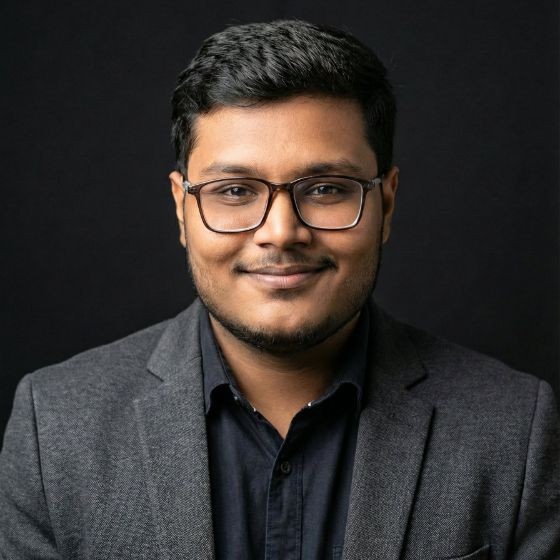
Samrat Chakraborty
2
First-Author Papers (Langmuir Published & Finalized for Submission)
18
Countries in Global Research Initiative (STAI)
AIR 5
All India Rank (IACS Selection)
800×
HPC Trajectory Engine (<1.2 GB RAM)

What I Work On

I research interpretable machine learning and ML force fields (MLFFs) to probe collective physical phenomena that black-box models obscure and classical methods fail to quantify. Under Dr. Avisek Das at IACS, I developed a 3-tier interpretability framework (Descriptor Informativeness Index [DII], combinatorial ablation, and Shapley attribution) across system-tailored physical coordinate sets (ranging from 20 to 60+ descriptors depending on mixture complexity) to uncover the collective variables governing non-covalent bond lifetimes.


To make rigorous physical chemistry accessible without GPU cloud lock-in, I engineered a high-performance streaming trajectory engine with capped neighbor-lists that processes 200 ns runs of 100 Å bulk water boxes in under 10 minutes on <1.2 GB RAM (an 800× speedup over default MDAnalysis), while enabling surrogate models of ~5,000 water molecules to train on CPU in under 17 minutes. Across domains, my research is unified by a single conviction: models are mathematical probes to isolate physical causality, not black-box predictors. Whether formulating calibration-gated active learning metrics (ROE) for self-driving laboratories or architecting autonomous closed-loop telemetry systems (SATISH), I build systems where every prediction is physically grounded, auditable, and interpretable.
Selected Research Output

Highlights from 14+ research outputs. Preprints and full conference papers. Single-authored unless noted.

04

Hydrogels at the Biology–Physics–Chemistry Interface: Design Principles Guiding Emerging Frontiers

Samrat Chakraborty, Biswajit Dey* · Langmuir (ACS) · 2026 Langmuir (ACS) First-author Published · ACS

DOI: 10.1021/acs.langmuir.6c04432

2026
05

SATISH: AI-Powered Space Mission Risk Prediction — Real-Time Failure Detection and Adaptive Contingency Planning

International Astronautical Congress (IAC) 2025 & 2026  — World’s largest space science conference Preselected · Acta Astronautica Oral Presentation Published
2025
06

PRASNA: Explainable AI Framework for Semantic Drift Analysis in Indian Knowledge Systems

Visva-Bharati National Conference on IKS Oral Presentation Published

Methodological overlap: Applied XAI latent space analysis to LLMs—techniques directly transferable to ML force fields.

2025

Where I've Worked

M.Sc. Research — Machine Learning Force Fields
Dr. Avisek Das  ·  IACS, Kolkata
June 2025 — Present
Summer Internship (Jun–Jul 2025) → M.Sc. Research (Aug 2025 — Present)
  • Developed the group's MLFF computational infrastructure from scratch — code, simulation pipelines, and research directions — establishing a new research program in the lab
  • Engineered a custom high-performance streaming trajectory engine with capped neighbor-lists and temporal correlation caching: processes 200 ns trajectories of 100 Å bulk water boxes in <10 minutes strictly under 1.2 GB RAM (reducing compute time from 10 days to 18 minutes; ~800× speedup over default MDAnalysis)
  • Developed a 3-tier interpretability framework (Descriptor Informativeness Index [DII], combinatorial coordinate ablation, and Shapley attribution) across system-tailored physical coordinate sets (20 to 60+ descriptors) to uncover the collective variables governing non-covalent bond lifetimes
  • Engineered compact CPU surrogate architectures training on ~5,000 water molecules across trajectories in <17 minutes on CPU with 6 GB RAM, enabling rapid hypothesis testing and dozens of ablations without GPU cloud lock-in
  • Authored the Return on Experiment (ROE) framework, introducing an empirical coverage gating condition (ĉ_0.95) to prevent autonomous self-driving labs from chasing miscalibrated uncertainties
  • Extending the interpretable H-bond dynamics pipeline across five water models (SPC, SPC/E, TIP3P, TIP4P, TIP5P) and HFIP–IPA solvent mixtures to study non-covalent selectivity
Research — Supramolecular Chemistry
Dr. Biswajit Dey  ·  Leading researcher in metallogel & metallohydrogel
2023 — Present
  • Ongoing research collaboration since B.Sc. 2nd year — 3+ years of sustained mentorship
  • First-authored paper published in Langmuir (ACS, 2026, doi: 10.1021/acs.langmuir.6c04432): S. Chakraborty, B. Dey* — supramolecular hydrogel design principles and emerging catalytic frontiers
  • Second first-authored manuscript in final preparation for submission: S. Chakraborty, B. Dey*
  • Wet-lab synthesis, rheological characterization, and molecular modeling of low molecular weight gelators (LMWG)
Founder & Lead Architect — STAI Research Cohort
STAI Research Initiative (in association with Space Generation Advisory Council [SGAC] & UNOOSA)  ·  stais.dev
2025 — Present
  • Founder, First & Corresponding Author, and Lead Architect: Directed an international research cohort across 18+ countries (60+ researchers; members from Stanford, Harvard, IITs, IISc, IST Islamabad)
  • Architected SATISH — a Docker-containerized, end-to-end autonomous Decision Support System (DSS) coupling sequence-to-sequence recurrent autoencoders (LSTM temporal latent encodings) with closed-loop contingency mitigation environments
  • Validated on empirical ESA M1/M2 spacecraft mission telemetry, deploying real-time reconstruction anomaly scoring against non-stationary operational states
  • Delivered Oral Presentation at IAC 2025; preselected for fast-track publication in Acta Astronautica by IAC session chairs; second iteration accepted for IAC 2026
Research Mentor — REYES Program
UC Berkeley
2025
  • Competitively Selected Research Project Lead: Authored independent project proposal selected as the #1 most sought-after project in the entire program (89 applicants)
  • Personally evaluated, interviewed, and directed a research cohort of 39 selected researchers through complex computational modeling

Academic Background

Current
Integrated M.Sc.–Ph.D. in Chemical Sciences
Indian Association for the Cultivation of Science (IACS), Kolkata
National selection: AIR 9 (written) → AIR 5 (final merit, post-interview)
Asia’s oldest scientific research institute, est. 1876  ·  C.V. Raman — Asia’s first Nobel in science
M.Sc. 2nd Year
2025 — Present
M.Sc. Chemistry — Selected, Declined
Jawaharlal Nehru Centre for Advanced Scientific Research (JNCASR), Bengaluru
1 of 20 selected nationally via written test + interview  ·  Declined for IACS integrated program
2025
B.Sc. (Hons.) Chemistry  ·  Minors: Physics & Mathematics
Visva-Bharati University, Santiniketan
CGPA: 7.79/10  ·  1st rank in Semester 1  ·  GATE 2025: AIR 2016, Score 409 (in final year)
UNESCO Living Heritage  ·  Rabindranath Tagore — Asia’s first Nobel laureate
2022 — 2025
Additional Selections & Programs
50th IUPAC World Chemistry Congress (WCC 2025) — Oral Presentation Selection  ·  SGAC Delegate — UN STSC Session, Vienna (2025)  ·  IISc Bengaluru — Research Internship (2024)  ·  DRDO SSPL, New Delhi (2025)  ·  DRDO DYSL (2026)  ·  Womanium & WISER Quantum Program (top 20%, 2025)  ·  Agnirva Space Technology Program (AICTE, 2024)

Community & Review

Editorial Team Lead
ACS Student Chapter, IACS Kolkata
Peer Reviewer — RSC Advances
Verified review (certified)  ·  ACS Reviewer Lab completed

Tools & Methods

Computational Chemistry
OpenMM MDAnalysis DeepMD Gaussian VMD
Machine Learning
PyTorch scikit-learn Qiskit PennyLane
Languages
Python Tcl Docker
Methods
ML Force Fields Molecular Dynamics DFT Explainable AI
Practical / Web
SEO AEO Full-Stack Development

Get in Touch

Open for doctoral research opportunities, collaborations, and discussions on computational chemistry and explainable AI.

@
Institutional
GS
Google Scholar
in
LinkedIn
08 — References

Letters of Recommendation

Available upon request from 5 academic supervisors, including 3 Fellows of the Royal Society of Chemistry (FRSC).

Full referee details provided with applications.